
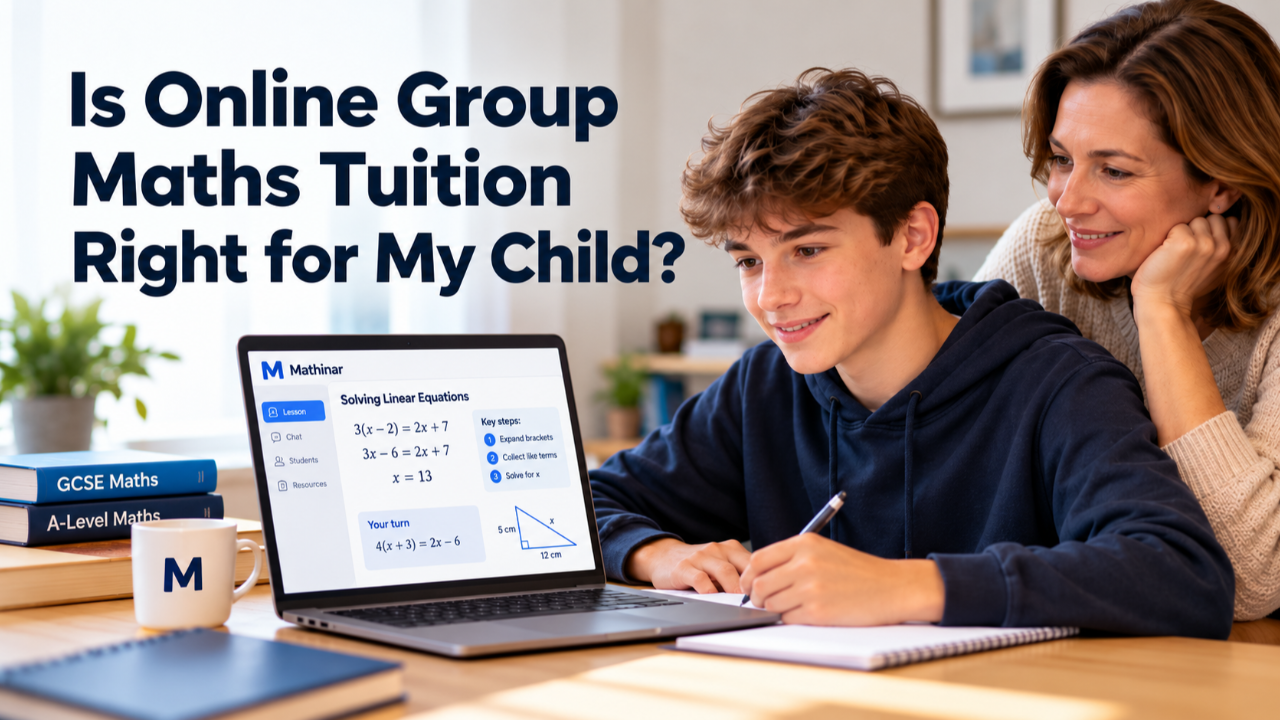
Online group maths tuition can work extremely well for the right student.
But it is not automatically the best option for every child.
Some students thrive in a small online group. They enjoy answering questions, seeing how other students think and being challenged by harder problems.
Others need more individual support, particularly if they have significant gaps in their knowledge or struggle to work independently.
So before deciding whether online group tuition is right for your child, it is worth thinking carefully about how they learn.
The short answer
Online group maths tuition is likely to suit your child if they:
- are reasonably independent learners
- are willing to participate and answer questions
- want to improve towards the higher grades
- can follow explanations without needing constant one-to-one attention
- are willing to ask for help when they do not understand something
Being shy does not automatically mean group tuition will not work.
In fact, some shy students find online tuition easier because they can type answers privately rather than speaking in front of a room full of students.
However, if your child needs constant individual support, has large gaps in their maths knowledge or is unwilling to participate, one-to-one maths tuition may be a better starting point.
What makes a student suitable for online group maths tuition?
The most important thing is not whether a student is naturally confident or outgoing.
It is whether they are willing to engage with the lesson.
In my classes, students are expected to answer questions throughout the session.
I am not expecting every answer to be correct. Making mistakes is an important part of learning.
But I do need students to attempt questions.
If a student simply watches the lesson without answering anything, it becomes very difficult for me to know whether they have understood the work.
That is why participation is such an important part of the way I teach.
Does my child need to be confident or outgoing?
No.
A student can be quiet, shy or naturally reserved and still do extremely well in online group tuition.
They do not need to be the type of student who puts their hand up constantly at school.
What matters is that they are willing to respond when asked.
Online tuition can actually make this easier for some students.
In my classes, students do not need to have their cameras switched on.
They can also answer questions privately so that only I can see their response.
Other students do not need to know whether an answer was right or wrong.
What if my child is shy?
This is one of the most common concerns parents have.
A shy student may worry about getting something wrong in front of other people.
That is why I deliberately structure the lessons so that students can participate without feeling exposed.
Students can type their answers privately.
If somebody makes a mistake, I do not announce who gave the incorrect answer.
I might simply say, “Someone has put 8. Have another look at that one.”
Or, “One student has asked a really good question here.”
This allows me to use mistakes and questions to help the whole class without embarrassing the student who asked them.
A shy student who is willing to engage privately can therefore be a very good fit for online group tuition.
How much participation is expected?
Quite a lot.
My lessons are designed to be interactive.
I ask questions throughout the session and expect students to attempt them.
Students are also encouraged to ask questions whenever something is unclear.
This is particularly important because online tuition should not become passive learning.
Simply watching somebody else do maths is very different from actually doing maths yourself.
The students who tend to make the strongest progress are the ones who actively answer questions, attempt the work and ask for help when they need it.
What happens during a free trial?
The free trial is not just for the student and parent to decide whether they like the class.
It also allows me to see whether the student is suited to the way I teach.
When a new student joins, I deliberately encourage them to answer questions throughout the lesson.
If they are quiet, I may ask them directly for an answer.
I do this because I want them to understand from the beginning that participation is part of the class.
If a student engages well during the trial, that is usually a very good sign.
If they are unwilling to participate even when encouraged, I will normally tell the parent that group tuition may not be the right option.
I would rather be honest about that than encourage somebody to join a programme that is unlikely to work for them.
When is one-to-one tuition a better choice?
Group tuition works best when students can follow the main lesson and need occasional help.
One-to-one tuition may be more appropriate when a student needs much more individual attention.
For example, a student may:
- have significant gaps in basic maths
- be working well below the level of the group
- need explanations repeated several times
- struggle to work independently
- lack confidence because they have been behind for a long time
In these situations, putting the student straight into a group may actually make things harder.
They can quickly feel that everybody else understands the work while they are struggling.
That can damage confidence rather than build it.
Sometimes the better approach is to use one-to-one tuition first, strengthen the foundations and then consider moving into a group later.
Can a student be too far behind for group tuition?
Yes.
This is something tutors do not always say clearly enough.
A student who is significantly behind may need more support than a group lesson can realistically provide.
For example, if I am teaching a Higher GCSE Maths topic and one student is missing several important prerequisite skills, I cannot stop the entire class for a long period while we rebuild those foundations.
That would not be fair to the other students.
It also would not necessarily be fair to the student who is struggling.
They may benefit far more from targeted one-to-one support.
Once those gaps have been addressed, group tuition may become a very good option.
What if my child is already very strong at maths?
Tuition is not automatically necessary just because a student is studying GCSE or A-Level Maths.
If your child is already consistently achieving the grade they want, understands the work and is being sufficiently challenged at school, they may not need additional tuition.
For some students, tuition is useful because they want additional challenge and want to move from a Grade 7 or 8 towards a Grade 9.
For others, it may simply be unnecessary.
I do not believe parents should pay for tuition simply because everybody else seems to be doing it.
There should be a clear reason for it.
If your main concern is whether your child will be sufficiently challenged or may struggle to keep up, read my guide on whether your child could be bored or left behind in group maths tuition.
Who is Mathinar group tuition designed for?
Mathinar group tuition starts from Year 9.
By this stage, I expect students to have enough maturity to work independently and take some responsibility for their own learning.
The classes are particularly aimed at students who want to work towards the higher grades.
For GCSE Maths, the focus is on students working towards Grades 7, 8 and 9.
This means the pace and level of challenge may not be suitable for every student.
A student who needs to rebuild basic foundations may benefit more from one-to-one tuition first.
If your child is already on the GCSE pathway and you are deciding when to begin, you may also find my guide When Should My Child Start GCSE Maths Tuition — and Is Year 11 Too Late? useful.
Group tuition or one-to-one tuition?
| Your child... | Group tuition may be... |
|---|---|
| Is aiming for Grades 7–9 and willing to participate | A very good fit |
| Is capable but shy | Often a good fit |
| Prefers typing answers rather than speaking publicly | A good fit |
| Needs occasional individual help | Usually suitable |
| Has significant gaps and needs constant individual attention | One-to-one may be better first |
| Is unwilling to answer questions or participate | Probably not suitable |
| Is already consistently working at their target grade | Tuition may not be necessary |
The important thing is to choose the type of tuition that matches the student rather than simply choosing the option that seems most convenient.
Does online tuition help students become more independent?
It can.
Online tuition requires students to take a little more responsibility for their learning.
They need to listen carefully, attempt questions, submit answers and ask for help when necessary.
Those are useful habits beyond maths as well.
But that only works if the student actively participates.
Online tuition should not mean sitting silently behind a screen.
My recommendation as a maths tutor and examiner
I would not choose group tuition simply because it is cheaper than one-to-one tuition.
And I would not choose one-to-one tuition simply because it sounds more personalised.
The question should be:
What type of support does this particular student actually need?
If your child is motivated, reasonably independent and willing to participate, a small online group can be extremely effective.
They benefit from structured teaching, challenging questions and seeing how other students approach problems.
If your child has significant gaps, needs constant individual attention or struggles to participate independently, one-to-one tuition may be the better starting point.
And if your child is already doing extremely well and achieving the grades they want, they may not need tuition at all.
Frequently asked questions
Is online group maths tuition suitable for shy students?
Yes. Shy students can often do very well because they can answer questions privately rather than speaking in front of the group. What matters is that they are willing to participate.
Does my child have to turn their camera on?
No. Students do not need to have their camera switched on during Mathinar lessons.
Will other students see my child's answers?
No. Students can submit their answers privately so that I can see them without the rest of the class seeing who answered correctly or incorrectly.
What happens if my child gets an answer wrong?
That is completely normal. I use mistakes as teaching opportunities without embarrassing individual students.
What if my child does not participate?
Participation is an important part of the class. If a student repeatedly refuses to answer questions or engage with the lesson, group tuition is unlikely to be the right option.
Is group tuition suitable for a student who is far behind?
Sometimes, but not always. If a student has significant gaps in their knowledge and needs constant individual attention, one-to-one tuition may be more appropriate initially.
Can my child move from one-to-one tuition into a group later?
Yes. In some cases, students benefit from strengthening their foundations through one-to-one tuition before moving into a group.
Is group tuition suitable for Grade 9 students?
It can be if the student still wants additional challenge. However, if they are already consistently achieving their target grade and are sufficiently challenged elsewhere, they may not need tuition.
What age does Mathinar group tuition start?
Mathinar group tuition starts from Year 9.
Can my child try a lesson before joining?
Yes. A free trial allows your child to experience the lesson format and gives me an opportunity to see whether the group environment is suitable for them.
Thinking about online maths tuition?
If you are unsure whether group tuition is right for your child, a free trial is often the easiest way to find out.
Your child can experience the lesson, answer questions and see how the online format works before you make a decision.
You can check current class availability, book a free trial, or learn more about one-to-one maths tuition if your child would benefit from more individual support.
