
By Anish | Maths Teacher, Experienced GCSE Examiner and Founder of Mathinar. 26 October 2026.
"Give your answer in terms of π" is one of the friendliest instructions on the GCSE Maths non-calculator paper. It means you never have to multiply by 3.14159... at all. Yet circle and 3D shape questions still cost Higher students marks, and the marks rarely go on the hard part. They go on a diameter used as a radius, a slant height used in a cone's volume, a hemisphere with its flat face missing, or 100 − 25π written as 75π.
This guide is for students taking GCSE Maths Higher in 2027, on any exam board, and for parents who want to help before the mocks. It covers what "in terms of π" actually asks for, a four-step routine for every circle and solid question, sectors and arcs, cones, spheres and frustums, shaded regions, working backwards from a π answer, and similar solids.
The short answer. "In terms of π" means leave π in your answer as a letter, like x. Use the radius, not the diameter. Take the right fraction of the circle. Collect π terms like algebra: 20π − 6π = 14π, but 50 − 6π can't be simplified. Then stop: no decimals, simplify any surds, and write the units.
What does "in terms of π" mean?
It means your answer should be a number multiplied by π, such as 18π cm2, or an exact expression with π in it, such as 100 − 25π cm2. You treat π as a symbol and never replace it with a decimal.
You will see it phrased in a few ways:
- "Give your answer in terms of π."
- "Give your answer as an exact value" or "Give the exact area" (π stays in, and so do surds such as √2).
- "Show that the volume is 96π cm3" (your working has to arrive at exactly 96π).
Why it matters. Writing a decimal instead can cost the final mark even when every step is right. On AQA's November 2024 Higher non-calculator paper, one question asked for a shaded area in terms of π. The correct answer was 135π. In the published mark scheme, a final answer of 424 (the decimal), or 135 with the π dropped at the end, scored three marks out of four: the method marks, but not the accuracy mark. An answer of 135 with no π anywhere in the working scored two.
Which formulas do you need to know? The national rules for GCSE Maths say you must know the circumference and area of a circle (C = 2πr = πd and A = πr2). The 2027 Higher formulae sheets we checked (AQA and OCR) print those two. The formulas for the volume and surface area of a cone and a sphere are ones you "need not memorise": they can be given in the question. The arc length and sector area formulas are not on the sheets, so you work them out as a fraction of the circle, as shown below. Check your own board's sheet, and learn the circle formulas anyway, because it saves time.
The SAFE routine for every circle and solid question
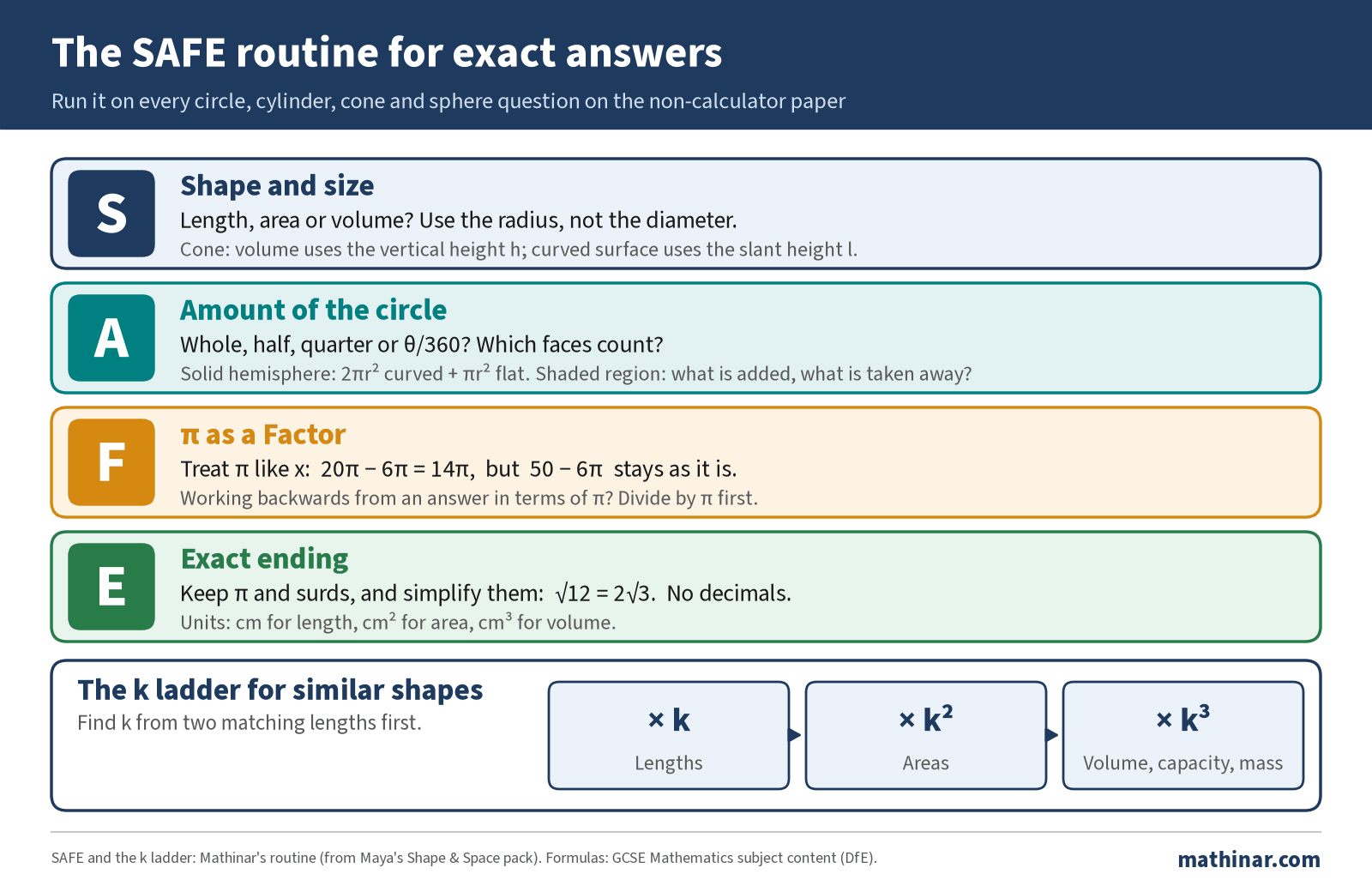
Run through these four checks on every question with a circle, a cylinder, a cone or a sphere in it.
- S: Shape and size. What shape is it, and are you finding a length, an area or a volume? Write down the radius. If you are given a diameter, halve it first. For a cone, the volume uses the vertical height h, and the curved surface uses the slant height l.
- A: Amount of the circle. Is it the whole circle, a half, a quarter, or a sector with angle θ, which is θ/360 of the circle? For a surface area, which faces count? Before you start a shaded region, write down which pieces are added and which are taken away.
- F: π as a factor. Treat π like the letter x. 20π − 6π = 14π, just as 20x − 6x = 14x. But 50 − 6π stays as it is, just as 50 − 6x does. When you work backwards from an answer with π in it, divide by π first.
- E: Exact ending. Keep π and any surds, and simplify them (√12 = 2√3). Don't round. Write the units: cm for lengths, cm2 for areas and cm3 for volumes.
Sectors and arcs: a fraction of the circle
A sector is a slice of a circle, and an arc is the curved edge of that slice. You don't need separate formulas. Work out what fraction of the whole circle you have, then take that fraction of the area or the circumference.
A sector has radius 9 cm and angle 80°. Find its area, its arc length and its perimeter, in terms of π.
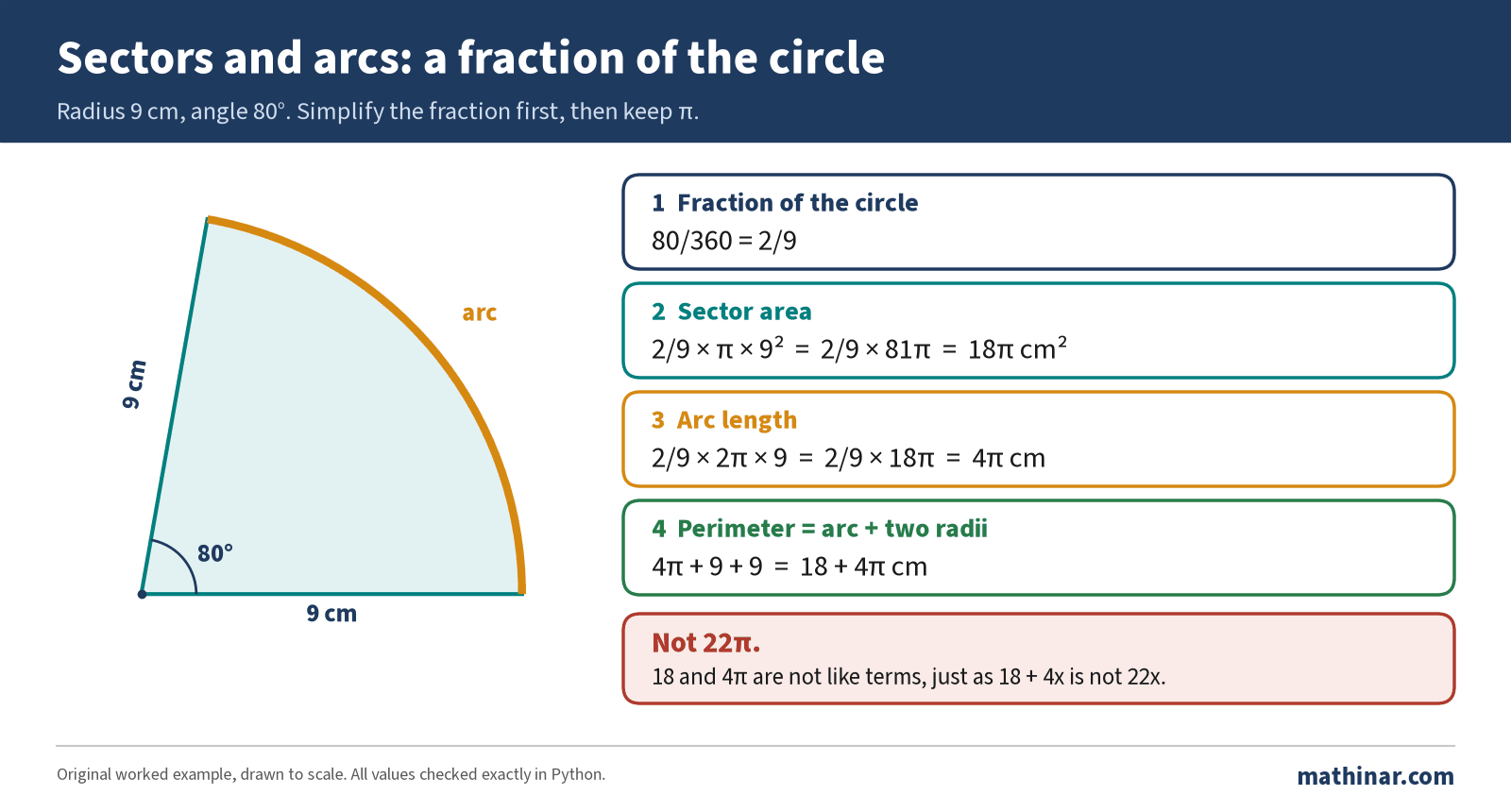
Fraction. 80/360 = 2/9. Simplify the fraction first, because it makes the arithmetic much easier without a calculator.
Area. The whole circle is π × 92 = 81π. The sector is 2/9 of that: 2/9 × 81π = 18π cm2.
Arc length. The whole circumference is 2 × π × 9 = 18π. The arc is 2/9 of that: 2/9 × 18π = 4π cm.
Perimeter. The perimeter is the arc plus the two straight edges, which are both radii: 4π + 9 + 9 = 18 + 4π cm.
The traps here. Writing 18 + 4π as 22π (18 and 4π are not like terms, just as 18 + 4x is not 22x). Giving the arc length when the question asked for the perimeter. Using 80/100 instead of 80/360. And mixing up sectors and segments: a segment is the region between a chord and an arc, not a slice. AQA's June 2025 examiners noted that many students "reversed the answers for sector and segment".
Cones: find the slant height with a Pythagorean triple
A cone has two different heights, and each formula uses a different one:
- Volume = 1⁄3πr2h, where h is the vertical height, from the tip straight down to the centre of the base.
- Curved surface area = πrl, where l is the slant height, from the tip down the side to the edge of the base.
The radius, the vertical height and the slant height make a right-angled triangle, with the slant height as the hypotenuse. So if you are given two of them, Pythagoras gives you the third. On the non-calculator paper, the numbers are usually chosen to make a Pythagorean triple, so it is worth knowing the common ones: 3, 4, 5 and its multiples (6, 8, 10 and 9, 12, 15), 5, 12, 13, 8, 15, 17 and 7, 24, 25.
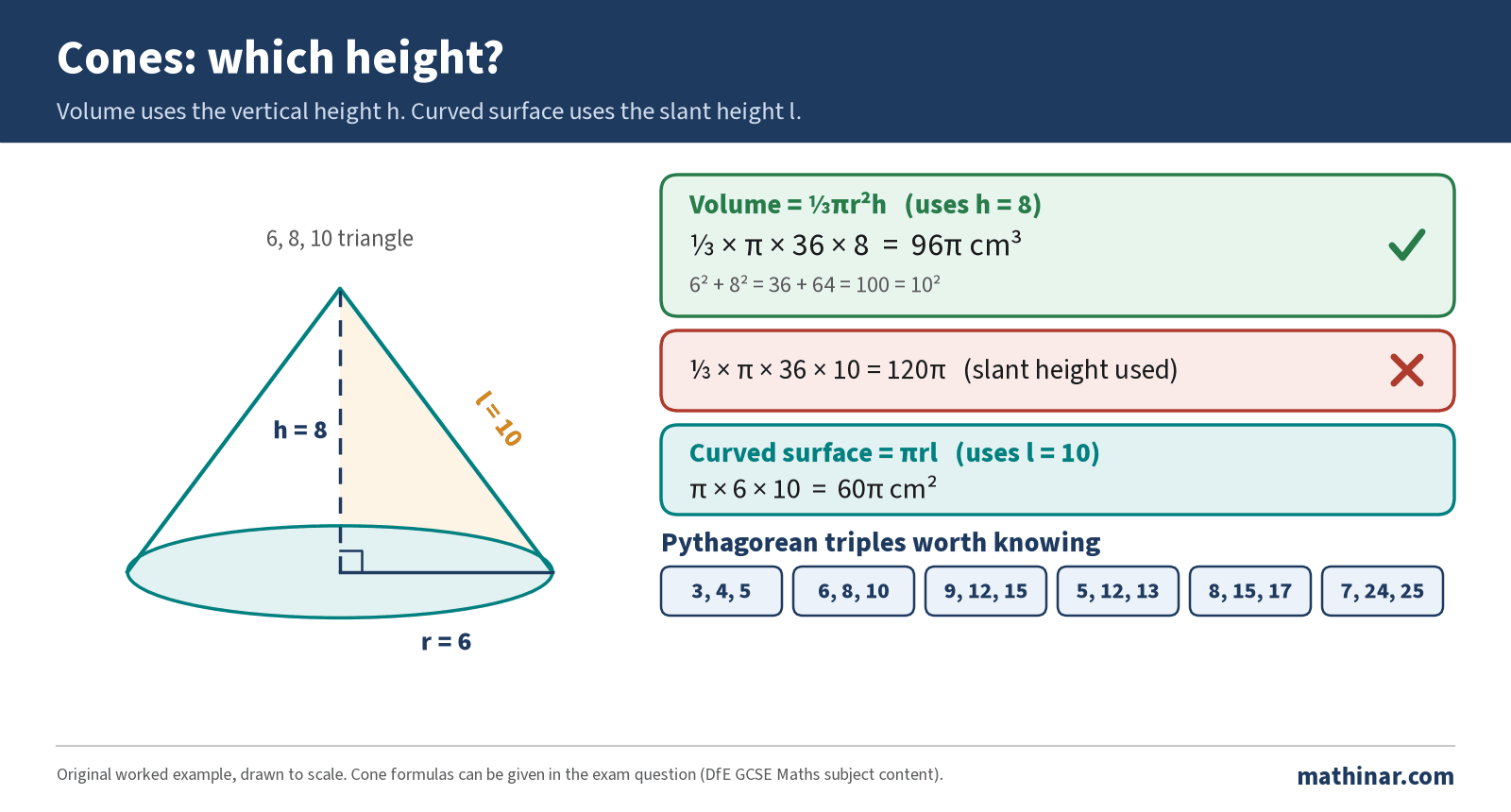
A cone has radius 6 cm and slant height 10 cm. Find its volume, in terms of π.
S. Volume needs the vertical height, and we have been given the slant height. The triangle is 6, ?, 10, which is the 6, 8, 10 triple, so h = 8 cm. (Check: 62 + 82 = 36 + 64 = 100 = 102.)
Work. V = 1⁄3 × π × 62 × 8 = 1⁄3 × π × 36 × 8 = 12 × 8 × π = 96π cm3.
The trap here. Putting the slant height into the volume formula gives 1⁄3 × π × 36 × 10 = 120π, which is wrong.
The other way round. A cone has radius 9 cm and vertical height 12 cm. Find its curved surface area. Now you need l, the slant height. 9, 12, ? is the 9, 12, 15 triple, so l = 15 cm, and the curved surface area is π × 9 × 15 = 135π cm2. Using the vertical height instead gives 108π. On AQA's June 2024 Higher non-calculator paper, one question printed the formula πrl and showed a student's curved surface area worked out with the vertical height instead of the slant height. Students had to spot the mistake.
If the question asks for the total surface area of a cone, add the circular base, πr2.
Spheres and hemispheres
For a sphere of radius r, the surface area is 4πr2 and the volume is 4⁄3πr3. A hemisphere is half a sphere, and this is where the A in SAFE matters most, because a solid hemisphere has two surfaces: the curved half of the sphere and a flat circle.
A solid hemisphere has radius 6 cm. Find its total surface area and its volume.
- Curved surface: half of 4πr2, so 2 × π × 62 = 72π cm2.
- Flat face: a circle, π × 62 = 36π cm2.
- Total surface area: 72π + 36π = 108π cm2. Forgetting the flat face gives 72π.
- Volume: half of 4⁄3πr3, which is 2⁄3 × π × 63 = 2⁄3 × 216π = 144π cm3.
Read the question carefully. A hollow bowl shaped like a hemisphere has no flat face to paint, so only the curved surface counts.
Frustums: a big cone minus a small cone
A frustum is a cone with its top sliced off parallel to the base, like a lampshade or a bucket. There's no frustum formula to learn. Work out the volume of the whole cone, then subtract the small cone that was removed.
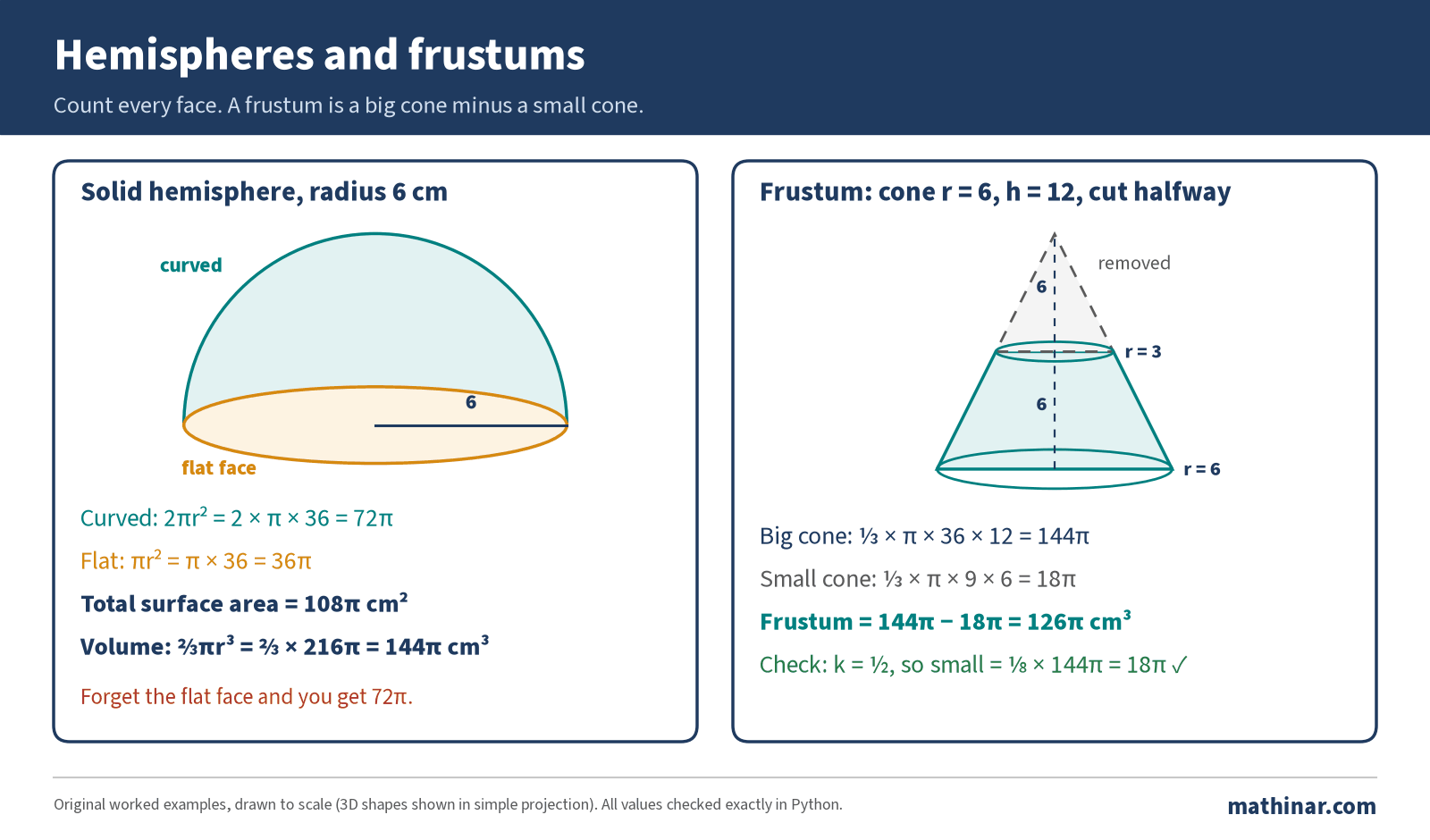
A cone has radius 6 cm and height 12 cm. The top is cut off halfway up, parallel to the base, to leave a frustum. Find the volume of the frustum.
Big cone. 1⁄3 × π × 62 × 12 = 1⁄3 × π × 36 × 12 = 144π cm3.
Small cone. It is cut halfway up, so its height is 6 cm and, by similar triangles, its radius is 3 cm. Its volume is 1⁄3 × π × 32 × 6 = 18π cm3.
Frustum. 144π − 18π = 126π cm3.
A quick check. The small cone is similar to the big one with a length scale factor of 1⁄2, so its volume is (1⁄2)3 = 1⁄8 of the big cone: 1⁄8 × 144π = 18π. ✓ (There is more on scale factors in the similar solids section below.)
Shaded regions and composite shapes
For a composite shape, write a word equation before any numbers, such as "shaded area = square − quarter circle". Then work out each piece in terms of π, and only combine terms that can be combined.
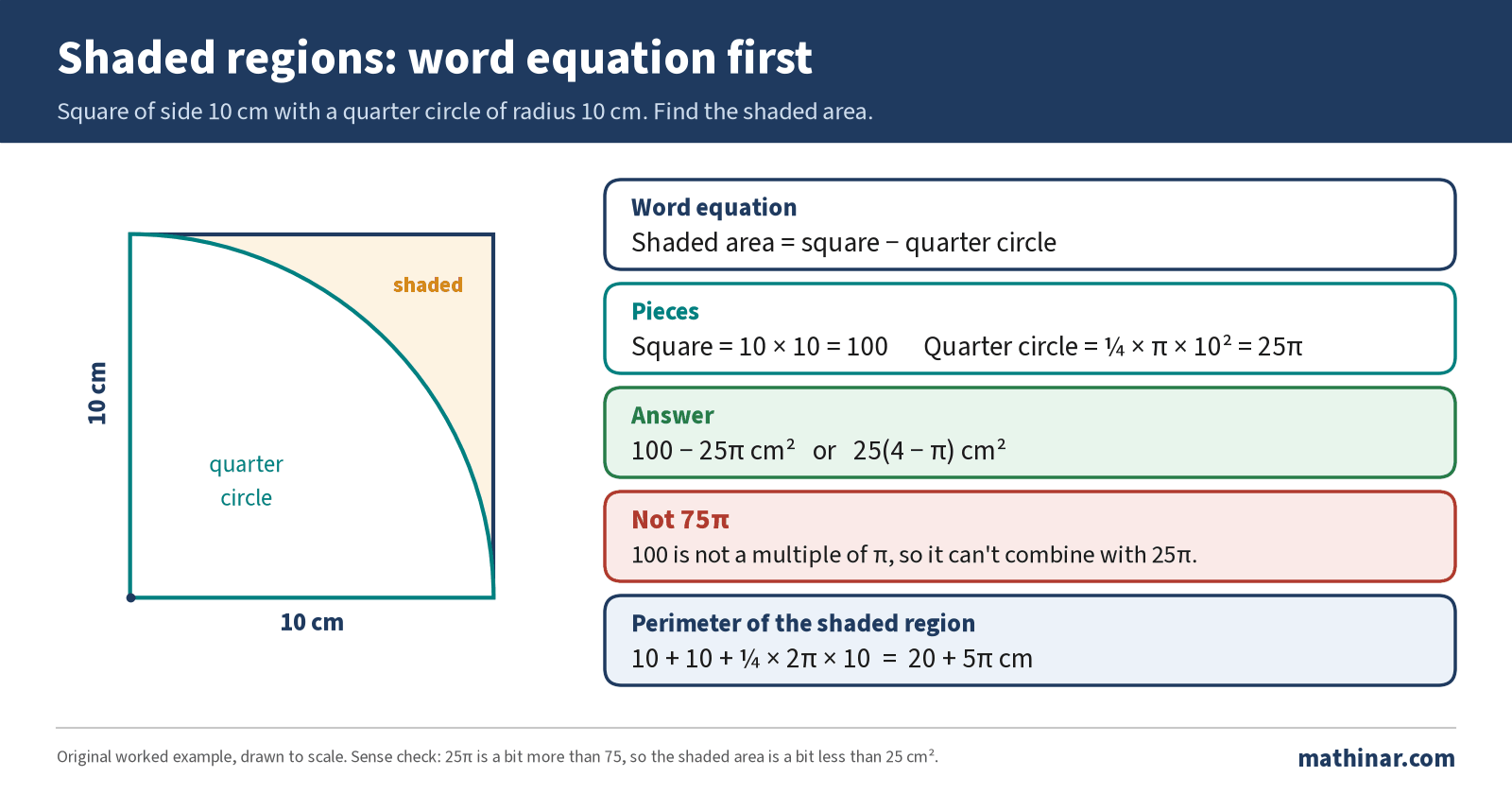
A square has side 10 cm. A quarter circle of radius 10 cm is drawn inside it, centred on one corner. Find the area of the region of the square outside the quarter circle.
Word equation. Shaded area = square − quarter circle.
Pieces. Square: 10 × 10 = 100. Quarter circle: 1⁄4 × π × 102 = 25π.
Answer. 100 − 25π cm2, or 25(4 − π) cm2. Both are exact. Writing 75π is the classic F slip: 100 isn't a multiple of π, so it can't be combined with 25π.
Sense check. π is a bit more than 3, so 25π is a bit more than 75, and the shaded area is a bit less than 25 cm2. That fits the diagram: the shaded corner is small.
The perimeter, if asked, is the two sides of the square that the arc doesn't touch, plus the arc: 10 + 10 + 1⁄4 × 2π × 10 = 20 + 5π cm.
Examiners' reports describe the same kinds of slip. On OCR's June 2025 Higher non-calculator paper, a question combined a sector and a semicircle. The examiners reported that "the most common error was then using 12 cm as the radius of the semicircle", which is the diameter, and that some students who used the right radius "calculated the area of the circle instead of the area of the semicircle". On AQA's November 2024 non-calculator paper, a common error was to say that "122 – 32 = 92", which turns 144π − 9π (correctly 135π) into 81π.
Working backwards from an answer in terms of π
Some questions give you the area or volume in terms of π and ask for a length. Write the formula equal to the answer, divide both sides by π first, and then solve.
A sector. A sector has angle 120° and area 12π cm2. Find the radius. 120/360 = 1⁄3, so 1⁄3 × πr2 = 12π. Divide by π: 1⁄3r2 = 12, so r2 = 36 and r = 6 cm. (Its arc length would then be 1⁄3 × 2π × 6 = 4π cm.)
A cylinder, with a surd answer. A cylinder has volume 40π cm3 and height 5 cm. Find the exact radius. πr2 × 5 = 40π. Divide by π: 5r2 = 40, so r2 = 8, and r = √8 = 2√2 cm. "Exact" means leave it as a surd, and simplify it: √8 = √4 × √2 = 2√2.
A sphere. A sphere has surface area 100π cm2. Find its volume, in terms of π. 4πr2 = 100π, so r2 = 25 and r = 5. Then V = 4⁄3 × π × 53 = 500⁄3π cm3. A fraction in front of π is fine. It is still exact.
Similar solids: length, area and volume scale factors
Two shapes are similar when one is an exact enlargement of the other. If the length scale factor is k, then:
- Lengths (heights, radii, perimeters) are multiplied by k.
- Areas (including surface areas) are multiplied by k2.
- Volumes, and therefore capacity and mass if the material is the same, are multiplied by k3.
Always find k from two matching lengths first.
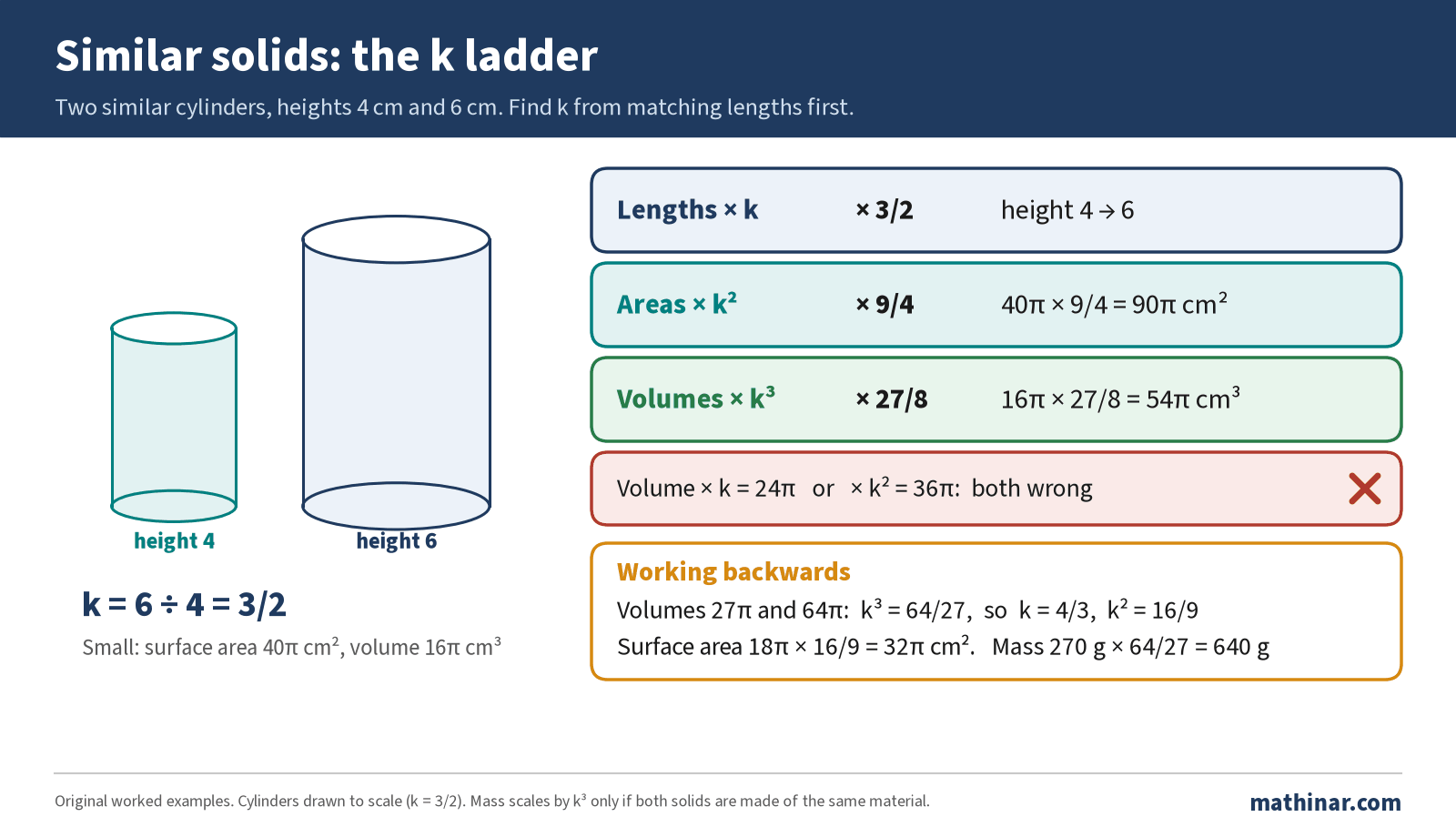
Two similar cylinders have heights 4 cm and 6 cm. The smaller one has surface area 40π cm2 and volume 16π cm3. Find the surface area and the volume of the larger one.
k. 6 ÷ 4 = 3/2. So k2 = 9/4 and k3 = 27/8.
Surface area. 40π × 9/4 = 90π cm2.
Volume. 16π × 27/8 = 54π cm3.
The traps here. Multiplying the volume by k gives 24π, and by k2 gives 36π. Both are wrong. On AQA's June 2025 Higher Paper 3, the examiners noted on a similar-shapes question that students who used the length scale factor "without squaring" it only gained part marks.
Working backwards. Two similar solids have volumes 27π cm3 and 64π cm3. The smaller has surface area 18π cm2. Find the surface area of the larger. The volume scale factor is 64/27 = k3. Take the cube root: k = 4/3. So the area scale factor is k2 = 16/9, and the surface area is 18π × 16/9 = 32π cm2. If the smaller solid has a mass of 270 g, the larger, made of the same material, has a mass of 270 × 64/27 = 640 g.
A last-minute checklist
Before you write the final answer to any circle or solid question, check:
- Did I use the radius, not the diameter?
- Did I use the right height for a cone (h for volume, l for curved surface)?
- Did I take the right fraction of the circle, and count every face?
- Did I only combine π terms with π terms?
- Did I leave π (and any surds) in, with no decimals?
- Are the units right: cm, cm2 or cm3?
There's more on the rest of the paper in our GCSE Maths non-calculator paper tips, including fractions, surds and exact trigonometry values.
Try the free Exact or Not? checker
Use the six-question Exact or Not? checker below to find out which type of slip is costing marks on circle and solid questions. It takes about ten minutes, works without a calculator, and marks each answer straight away.
At the end, it shows the main pattern behind any lost marks so you know what to fix next.
How Mathinar can help
Mathinar runs small online GCSE Maths group classes for students in Year 10 and Year 11, focused on the Higher tier. I teach every class myself. I have taught maths for more than 20 years and I am an experienced GCSE examiner. Each week includes a 60-minute live teaching lesson and a 30-minute homework class. Groups have a maximum of ten students, and the cost is £97 a month.
If you'd like to see whether the classes suit your child, you can try a group lesson free or read more about GCSE Maths at Mathinar. No grade can be guaranteed, but a routine your child runs on every circle and solid question turns easy-to-lose marks into marks they can rely on.
Frequently asked questions
What does "give your answer in terms of π" mean?
Leave π in the answer as a symbol, for example 18π cm2 or 100 − 25π cm2. Don't multiply it out as a decimal.
Do I lose marks if I give a decimal instead of an answer in terms of π?
You can. On some published mark schemes, a correct decimal or an answer with π left off loses the final accuracy mark, even though the method marks are still awarded. Follow the instruction in the question.
Can I simplify 50 − 6π to 44π?
No. 50 and 6π are not like terms, just as 50 − 6x is not 44x. You can only combine π terms with π terms: 20π − 6π = 14π.
Is the cone formula on the GCSE formula sheet?
The cone and sphere formulas are not on the 2027 AQA or OCR Higher formulae sheets. The national rules say they need not be memorised and can be given in the question when they are needed. You do need to know the circumference and area of a circle, and how to find arcs and sectors.
What's the difference between slant height and vertical height?
The vertical height goes straight down from the tip of the cone to the centre of its base. The slant height goes down the sloping side to the edge of the base. Volume uses the vertical height; curved surface area uses the slant height.
How do I find the area of a sector without a calculator?
Simplify the fraction of the circle first (for example 80/360 = 2/9), find the whole circle's area in terms of π, and multiply. For radius 9 cm and 80°: 2/9 × 81π = 18π cm2.
Does a hemisphere's surface area include the flat face?
For a solid hemisphere, yes: the total surface area is 2πr2 (curved) plus πr2 (flat), which is 3πr2. For an open bowl, only the curved surface counts.
How do scale factors work for similar solids?
If lengths are multiplied by k, areas are multiplied by k2 and volumes by k3. Find k from two matching lengths first, or take the square root of an area ratio or the cube root of a volume ratio.
