
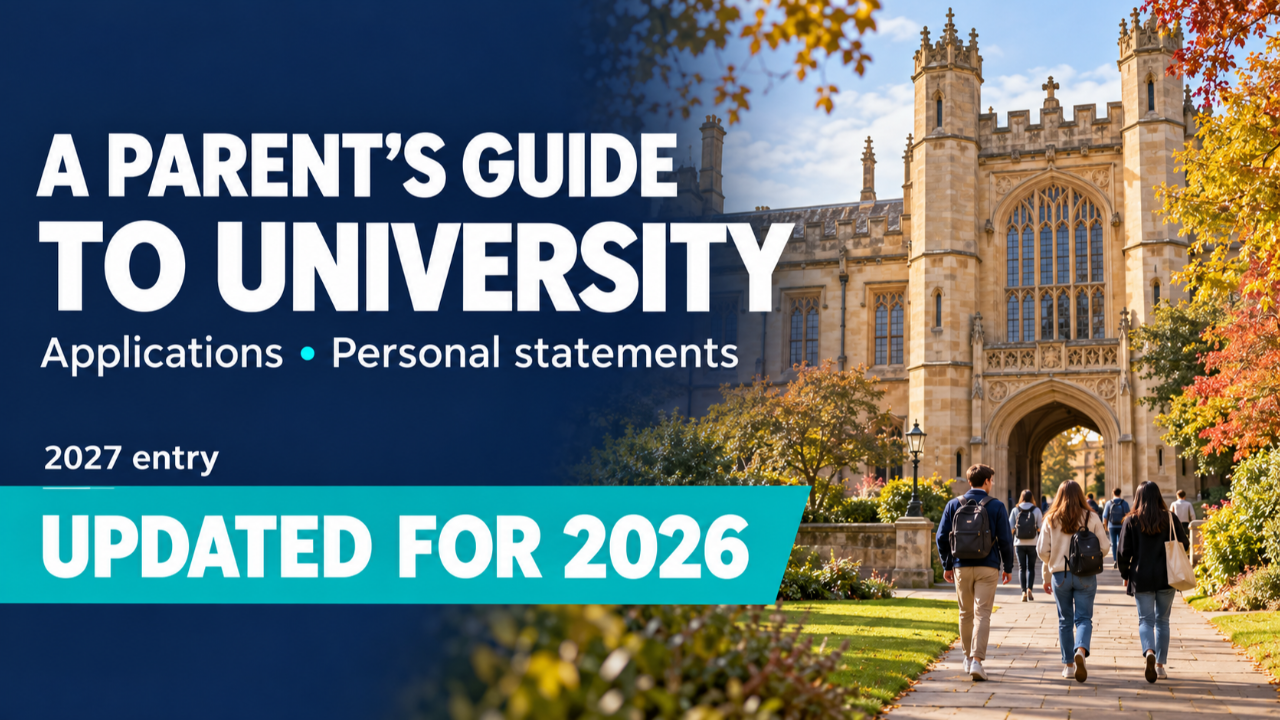
A Parent’s Guide to Applying to UK Universities
Updated September 2026 for students applying for 2027 entry.
Helping your child apply to university can feel overwhelming. There are courses to compare, deadlines to remember and a personal statement to write and the process may have changed since you last looked at it.
You don’t need to have all the answers. Helping your child stay organised, ask questions and make informed decisions can make a real difference.
Here’s a guide to the main steps.
1. Choosing a Course
Start with what your child wants to study. Encourage them to think about the subjects they enjoy, what interests them outside lessons and any careers they would like to explore.
When comparing courses, look beyond the title. Two universities offering the same subject may teach quite different content.
Use UCAS and individual university websites to check:
-
Course content: Which modules are compulsory, and which can students choose?
-
Entry requirements: What grades and subjects are needed?
-
Teaching and assessment: How much involves exams, coursework, practical work or independent study?
-
Opportunities: Are placements or study abroad available?
-
Location and costs: Would your child prefer to live at home or move away? What would accommodation and travel cost?
Check whether the course requires an admissions test, interview, audition or portfolio, and make a note of any separate deadlines.
2. Making the Most of Open Days
An open day can help your child work out whether a university feels right for them.
Alongside looking around the campus, encourage them to speak to current students, visit the department and explore accommodation.
Useful questions include:
-
What does a typical week on this course look like?
-
What do students enjoy most, and find most challenging?
-
What support is available if someone struggles academically or personally?
-
What are the accommodation options and costs?
Let your child lead some of the conversations. You can help by taking notes and discussing their impressions afterwards.
3. Why Year 12 Matters
For students taking A-levels, Year 12 helps build both the knowledge needed for Year 13 and the evidence teachers use when setting predicted grades.
Year 12 exams can be important, but they are not necessarily the only factor. Schools and colleges have their own processes, which may also consider classwork, assessments and progress over time.
Universities use predicted grades alongside other information when considering applications.
Encourage your child to work consistently and ask their teachers:
-
How are predicted grades decided?
-
When will they be finalised?
-
What should I focus on improving?
If your child is concerned about a prediction, an early conversation with their teacher is more useful than leaving it until the application deadline.
4. Understanding the UCAS Application
Through UCAS, students can usually apply for up to five course choices. These can be at different universities or include more than one course at the same university.
There are special restrictions for some applications, including medicine, dentistry, veterinary courses and Oxford or Cambridge, so check the relevant guidance when choosing.
Aim for a balanced selection of courses with realistic entry requirements, including options your child would be happy to attend if their results are lower than hoped.
Key deadlines for 2027 entry
-
15 October 2026, at 6pm UK time: Oxford, Cambridge, and most medicine, dentistry and veterinary medicine/science courses.
-
13 January 2027, at 6pm UK time: Most other undergraduate courses.
These are the main equal consideration deadlines, meaning applications received by the relevant deadline must be considered equally.
For this application cycle, students could start their application from 12 May 2026 and submit a completed application from 1 September 2026.
Check your school or college’s internal deadline. It will be earlier than the UCAS deadline to allow time for references and checks. Some specialist courses use different deadlines, so always check the individual course.
5. The New Personal Statement Format
The personal statement changed for 2026 entry onwards. Students now answer three separate questions.
In simple terms, these cover:
-
Motivation: Why they want to study the subject.
-
Academic preparation: How their qualifications and studies have prepared them.
-
Other preparation: What they have done outside formal education and why those experiences are useful.
There is a total limit of 4,000 characters, including spaces, with at least 350 characters for each answer. The remaining space can be divided however suits the student.
Encourage your child to use specific examples and explain what they learnt. Relevant reading, projects, part-time work, volunteering or caring responsibilities can all provide material.
The aim is to show how their experiences connect to their chosen subject, rather than simply list activities.
You can help by asking questions and reading drafts, while keeping their own voice and ideas.
The UCAS personal statement guide contains the exact questions and further advice.
What about AI?
AI tools can help students brainstorm or organise their thoughts, but the final statement should be their own work and reflect real experiences.
UCAS warns that copying and submitting all or a substantial part of an AI-generated statement as their own could affect their chances of an offer.
They should also avoid copying other people’s statements or including experiences they haven’t had.
6. Preparing for Interviews
Some courses and universities require interviews. Check each university’s guidance so your child knows what to expect.
Useful preparation includes revisiting their application, researching the course and practising explaining their thinking aloud.
You can help by asking them about their subject interests and giving them time to answer. The aim is to help them feel comfortable discussing their ideas, rather than memorising a script.
7. Choosing Firm and Insurance Offers
Once universities have responded, your child will need to decide which offers to accept.
A conditional offer means they still need to meet certain requirements, usually including exam results.
Their firm choice is their first choice. If they accept a conditional firm offer, they can usually also select an insurance choice as a backup.
An insurance choice should ideally have lower offer conditions and be somewhere they would be happy to study.
These are not simply two options to choose between on results day. If their firm place is confirmed, that is normally where they will be placed.
Their deadline for replying will appear in their UCAS application. Make a note of it together.
8. Getting Ready for Results Day
Before results day, encourage your child to have their UCAS login, offer conditions and university contact details ready.
Once they receive their results, they should check their UCAS application to see whether their place has been confirmed.
If they meet their offer conditions: They can follow the university’s instructions for the next steps.
If they miss the grades: They should check their application status before assuming they have lost their place. A university may still accept them.
If a decision is pending or unclear, your child should contact the university for guidance. You can support them by helping prepare questions and keeping the relevant information nearby.
If they have no confirmed place, Clearing may help them find a suitable course with vacancies. Encourage them to check the course carefully and make a considered decision.
A Simple Checklist for Parents
To help your child get started:
-
Confirm the school or college’s application deadline.
-
Check course requirements and any additional selection steps.
-
Discuss predicted grades with the school where needed.
-
Help your child gather examples for their personal statement.
-
Keep application, interview and reply dates in one place.
-
Talk through accommodation and living costs.
Your child doesn’t need to make every decision at once. Taking the process one step at a time and having someone calm to talk it through with can make it much more manageable.
