
By Anish | Maths Teacher, GCSE Examiner and Founder of Mathinar. Updated 20 October 2026.
Every GCSE Maths student sits one non-calculator paper. For AQA and Edexcel it is Paper 1. For OCR it is the middle paper: Paper 5 at Higher tier. It is worth one third of the GCSE, it lasts 1 hour 30 minutes, and it can test any topic on the specification.
This guide is for Higher tier students and their parents. It covers which paper is non-calculator for each exam board, the 2027 dates, what the paper really tests, where students lost marks in the most recent examiner reports, and a simple plan for the mock season.
If you're looking specifically for the types of questions and topics students commonly practise for the non-calculator paper, see our GCSE Maths non-calculator topics, tips and question types guide.
Which paper is the non-calculator paper?
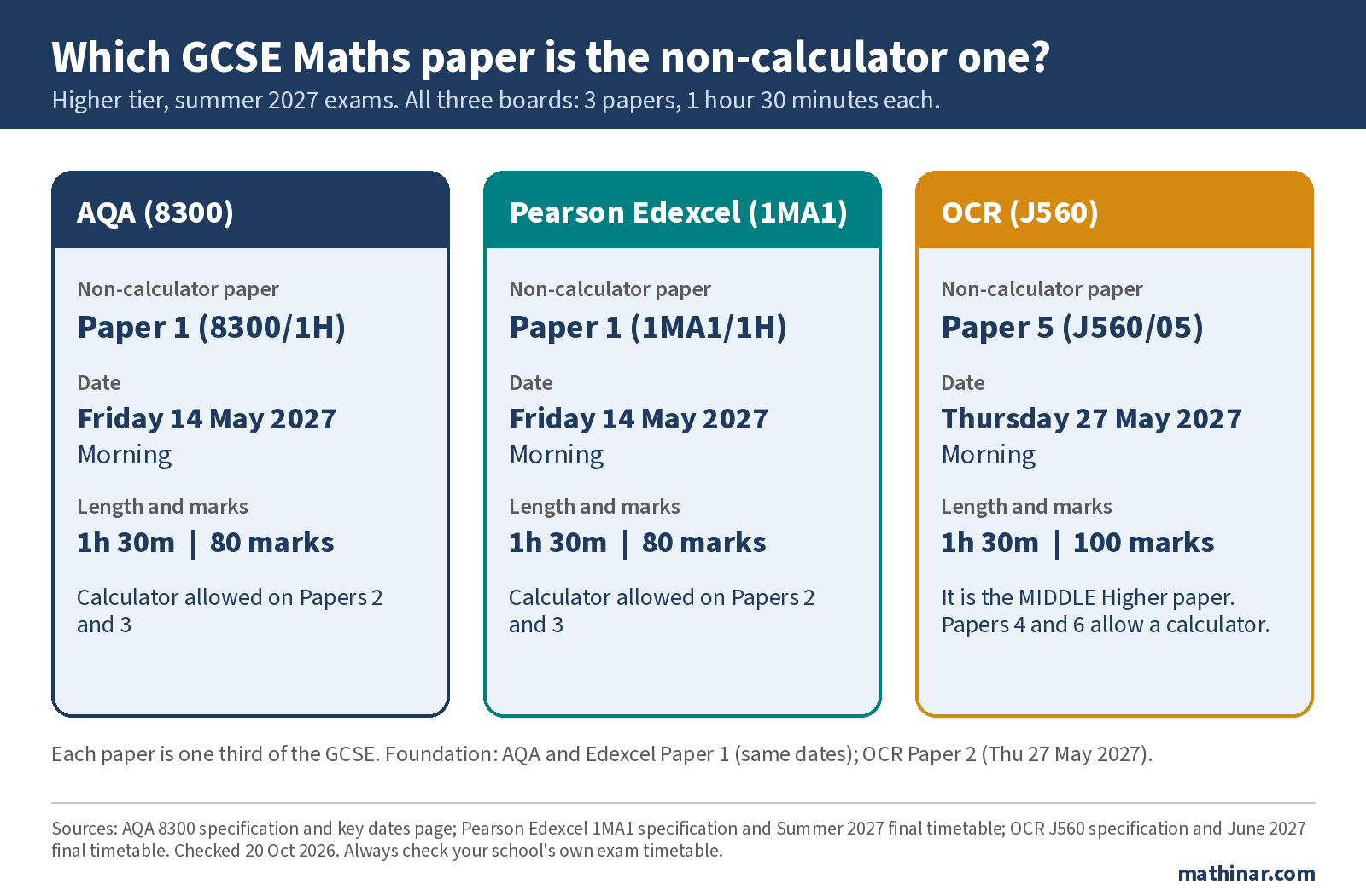
All three main exam boards set three papers of 1 hour 30 minutes each. Each paper is worth one third of the GCSE. Only one of them is non-calculator.
| Exam board | Non-calculator paper (Higher) | Marks | 2027 date | Calculator papers |
|---|---|---|---|---|
| AQA (8300) | Paper 1 (8300/1H) | 80 | Friday 14 May 2027, morning | Papers 2 and 3 |
| Pearson Edexcel (1MA1) | Paper 1 (1MA1/1H) | 80 | Friday 14 May 2027, morning | Papers 2 and 3 |
| OCR (J560) | Paper 5 (J560/05) | 100 | Thursday 27 May 2027, morning | Papers 4 and 6 |
At Foundation tier the non-calculator paper is Paper 1 for AQA and Edexcel (same date), and Paper 2 for OCR (Thursday 27 May 2027).
The OCR order catches people out. An OCR student's first maths exam allows a calculator, and the non-calculator paper comes second, so OCR students should not assume "Paper 1 is the non-calculator one".
Dates are from the AQA 8300 key dates page, the Pearson Edexcel Summer 2027 final timetable and the OCR June 2027 final timetable, checked on 20 October 2026. Your school's own timetable is the one to follow on the day. All the GCSE Maths dates are in our GCSE Maths exam dates 2027 guide.
What does the non-calculator paper test?
The short answer is: anything. AQA's specification says that "All content can be assessed on any of the three question papers". OCR says that "All content may be assessed on either the calculator or non-calculator papers". Pearson says the content for each tier "will be assessed across all three papers".
So there is no official list of "Paper 1 topics". Lists that claim certain topics will only come up on the non-calculator paper are guesses. A student who skips a topic because "it's a calculator topic" is taking a risk. For example, OCR's June 2025 non-calculator Higher paper included a question using the cosine rule.
What the non-calculator paper does change is how the maths has to be done. Without a calculator, students need to:
- Do written arithmetic quickly and accurately. That means long multiplication, division (including dividing by a decimal), negative numbers, and fractions and decimals.
- Keep answers exact. The national subject content for GCSE Maths asks students to "calculate exactly with fractions, surds and multiples of π". On a non-calculator paper, questions can expect exact answers such as 5/33 or 5√7 (both were final answers on the June 2025 Edexcel Paper 1H), not a rounded decimal.
- Know facts a calculator would normally supply. Examples are square and cube numbers, prime factors, and the exact values of sin and cos for 0°, 30°, 45°, 60° and 90°, and of tan for 0°, 30°, 45° and 60°, which the subject content says students must know.
- Use structure instead of brute force. That means factorising before multiplying out, cancelling before multiplying, and using standard form to handle very large or very small numbers.
These topics are likely to need non-calculator methods, so they are good to practise without a calculator. They are not a prediction of what will come up:
| Area | Non-calculator skills worth practising |
|---|---|
| Number | Fractions and mixed numbers, all four operations; dividing decimals; product of primes, HCF and LCM; indices including negative and fractional powers; standard form; surds and rationalising the denominator; recurring decimals to fractions; estimation |
| Algebra | Expanding and factorising; solving linear and quadratic equations and inequalities; simultaneous equations; completing the square; rearranging formulae; algebraic fractions; algebraic proof; functions and composite functions |
| Ratio and proportion | Sharing in a ratio; percentage change and reverse percentages using simple multipliers; direct and inverse proportion |
| Geometry | Angles and polygons; circle theorems with reasons; similarity and congruence proofs; exact trig values; Pythagoras with exact answers; area, volume and arc length in terms of π; transformations; vectors |
| Probability and statistics | Probabilities with fractions, including tree diagrams and Venn diagrams; quartiles and inter-quartile range; histograms (frequency = frequency density × class width) |
Students still get the formula sheet in 2027. Our GCSE Maths formula sheet 2027 guide explains what is on it and what still has to be learned.
One more format point. AQA papers can still include a few short "Circle your answer" questions. There was one on the June 2025 Paper 1H and two on the June 2022 Paper 1H. The June 2025 Edexcel Paper 1H had none. Every other question needs written working.
Where marks were lost: the June 2025 examiner reports
Each exam board publishes a report on how students did on each paper. The latest public reports for the Higher non-calculator papers are from June 2025. Their messages are very consistent.
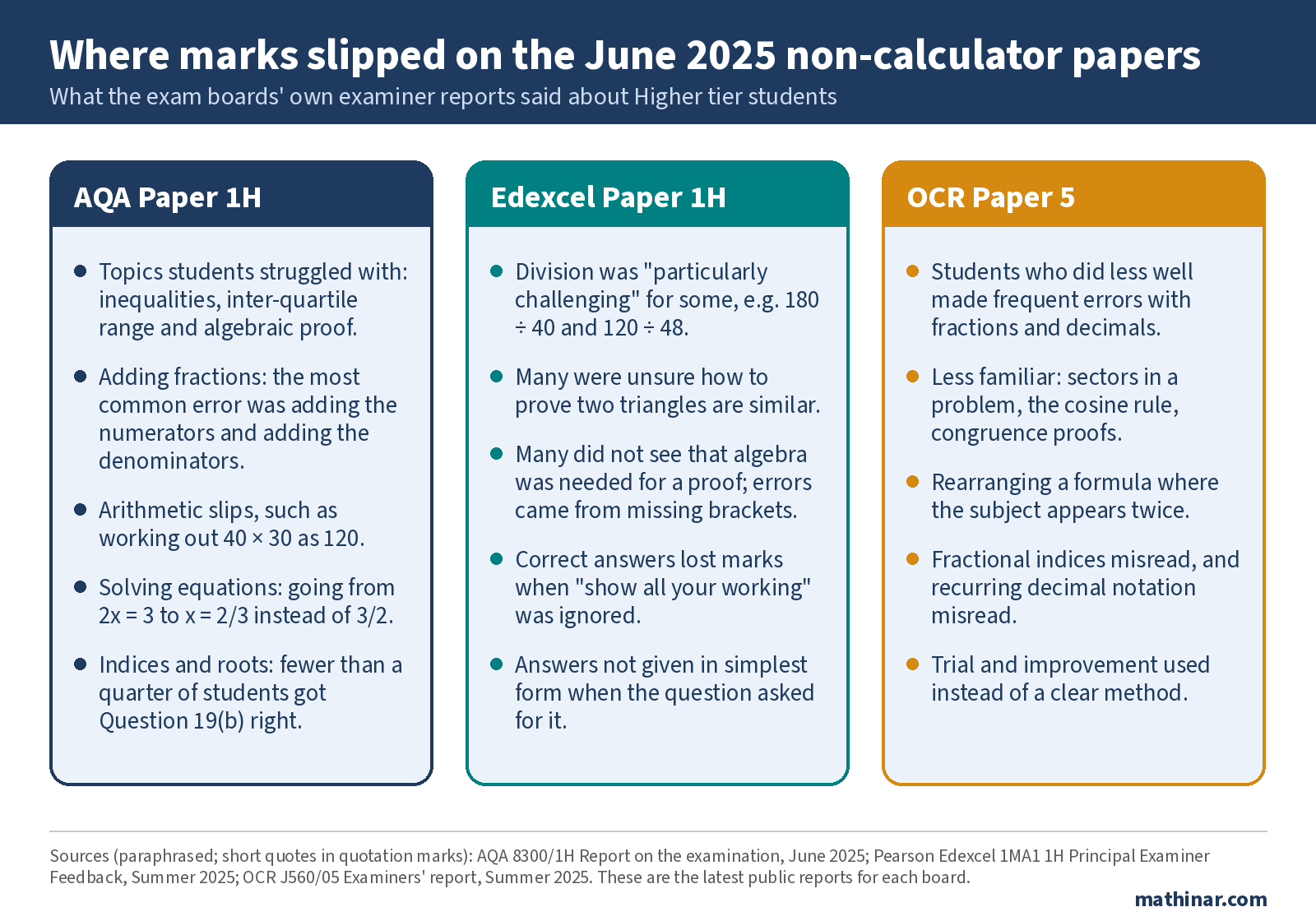
AQA Paper 1H (June 2025). AQA reported that students did well on simple simultaneous equations, frequency trees, ratio, simplifying surds and completing the square. They struggled with inequalities, inter-quartile range and algebraic proof. On adding fractions, "by far the most common error was to simply add the numerators and add the denominators". Plain arithmetic slips cost marks too, such as working out 40 × 30 as 120. At the end of solving an equation, some students went from 2x = 3 to x = 2/3 instead of x = 3/2.
Edexcel Paper 1H (June 2025). Pearson's examiners said that "the overall standard of arithmetic was good", but that division calculations such as 180 ÷ 40 and 120 ÷ 48 "appeared to be particularly challenging for some candidates". Many students were unsure how to prove that two triangles are similar. Many did not realise that a proof question needed algebra. When they did use algebra, marks were often lost to algebraic errors or missing brackets. The report's closing advice is for students to practise arithmetic, "particularly division and operations with decimals", and to check that answers are sensible.
OCR Paper 5 (Summer 2025). OCR said that students who did less well "made frequent computational errors, particularly when working with fractions or decimals". Topics that seemed less familiar included sectors in a problem-solving context, using the cosine rule, proving that two triangles are congruent, and rearranging a formula where the subject appears twice. Some students misread fractional indices or recurring decimal notation.
Put together, the reports point to two kinds of lost marks. One is arithmetic and accuracy: fractions, division and decimals, signs, and careless slips. The other is reasoning and proof: algebraic proof, similarity and congruence proofs, and giving reasons. Both can be practised.
How a right idea can still lose marks
Non-calculator papers give method marks as well as accuracy marks. That is good news for a student who shows working. It is bad news for one who doesn't.
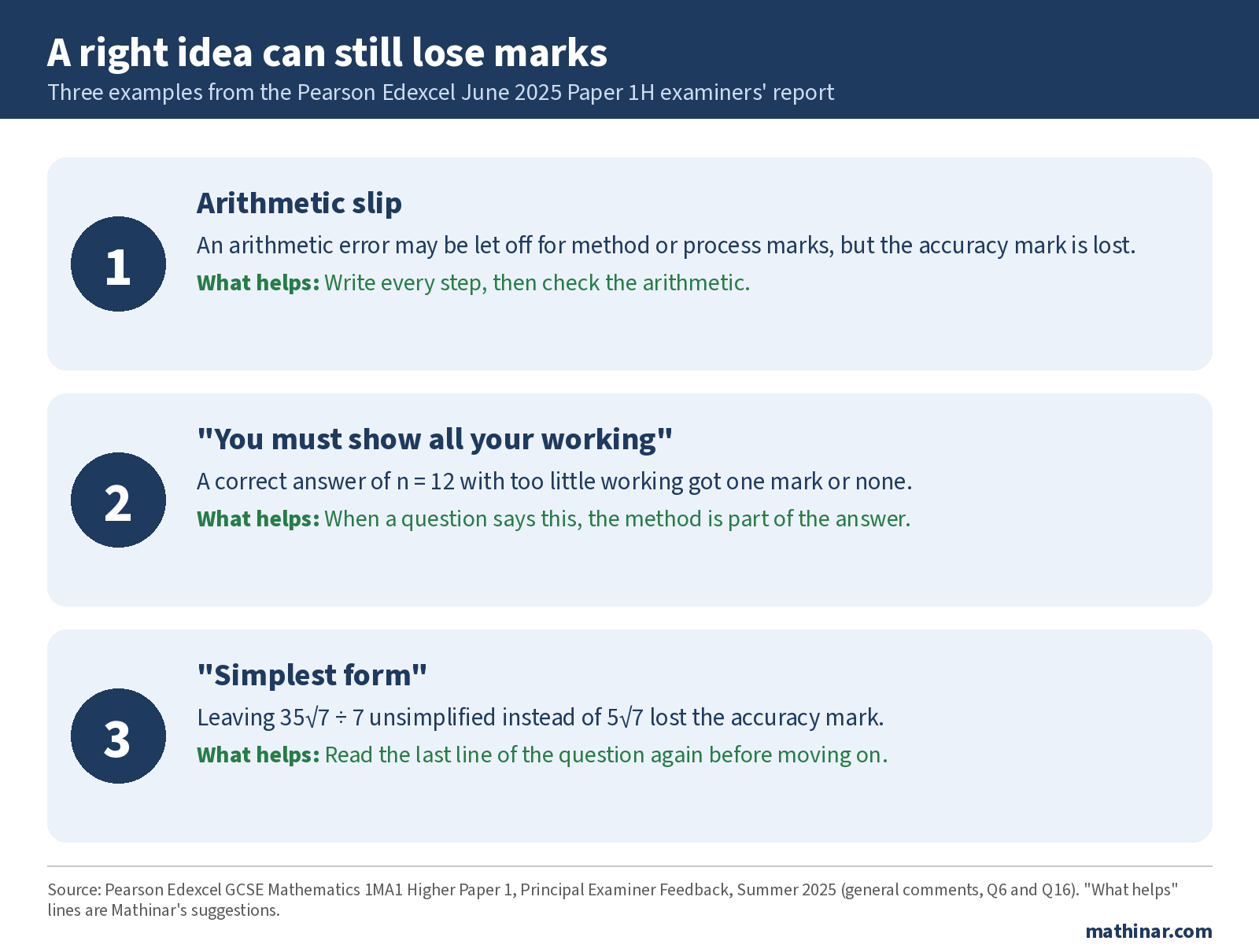
Pearson's June 2025 report gives three clear examples:
- Arithmetic slips. "Whilst arithmetic errors may be condoned in the awarding of method or process marks, accuracy marks would not be awarded." A correct method with a slip can still earn something, but only if the method is written down.
- "You must show all your working." On a polygon question with this instruction, some students with the correct answer of 12 "obtained only one mark or no marks because they did not contain sufficient supportive working".
- "Simplest form." When a surd answer was left as 35√7/7 instead of 5√7, the accuracy mark was not awarded.
The examiners' advice is that students "should pay particular attention to the final line of a question and follow any instructions given". For more on how marking works, see what examiners are actually looking for in GCSE Maths.
What does a non-calculator score mean?
Grades are awarded on the total across all three papers, not on one paper. But the exam boards also publish "notional" boundaries for each paper, which help when reading a mock result.
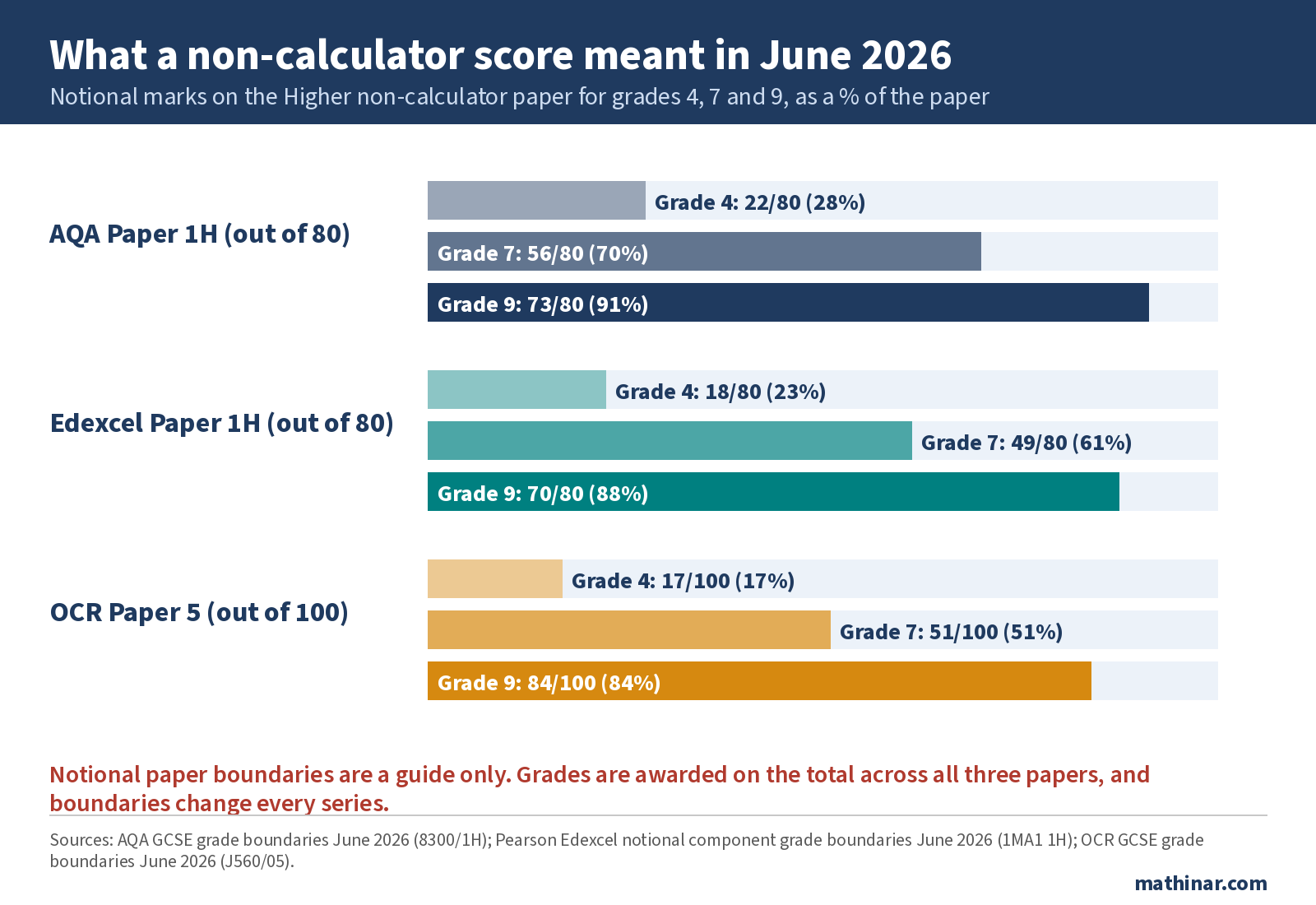
| June 2026 notional boundary | Grade 4 | Grade 5 | Grade 6 | Grade 7 | Grade 8 | Grade 9 |
|---|---|---|---|---|---|---|
| AQA Paper 1H (out of 80) | 22 | 33 | 44 | 56 | 64 | 73 |
| Edexcel Paper 1H (out of 80) | 18 | 28 | 38 | 49 | 59 | 70 |
| OCR Paper 5 (out of 100) | 17 | 28 | 40 | 51 | 67 | 84 |
Sources: AQA June 2026 grade boundaries, Pearson June 2026 notional component boundaries, OCR June 2026 grade boundaries.
These figures change every series, and a school mock may not be marked or graded in exactly the same way as the real exam. Use them as a rough guide only. For the full picture, see our AQA and Edexcel grade boundaries guides.
A four-week plan before a non-calculator mock
If your child has mocks coming up, a few weeks of focused practice can help. This plan is a suggestion, not an exam board requirement. Move it to fit your school's mock dates.
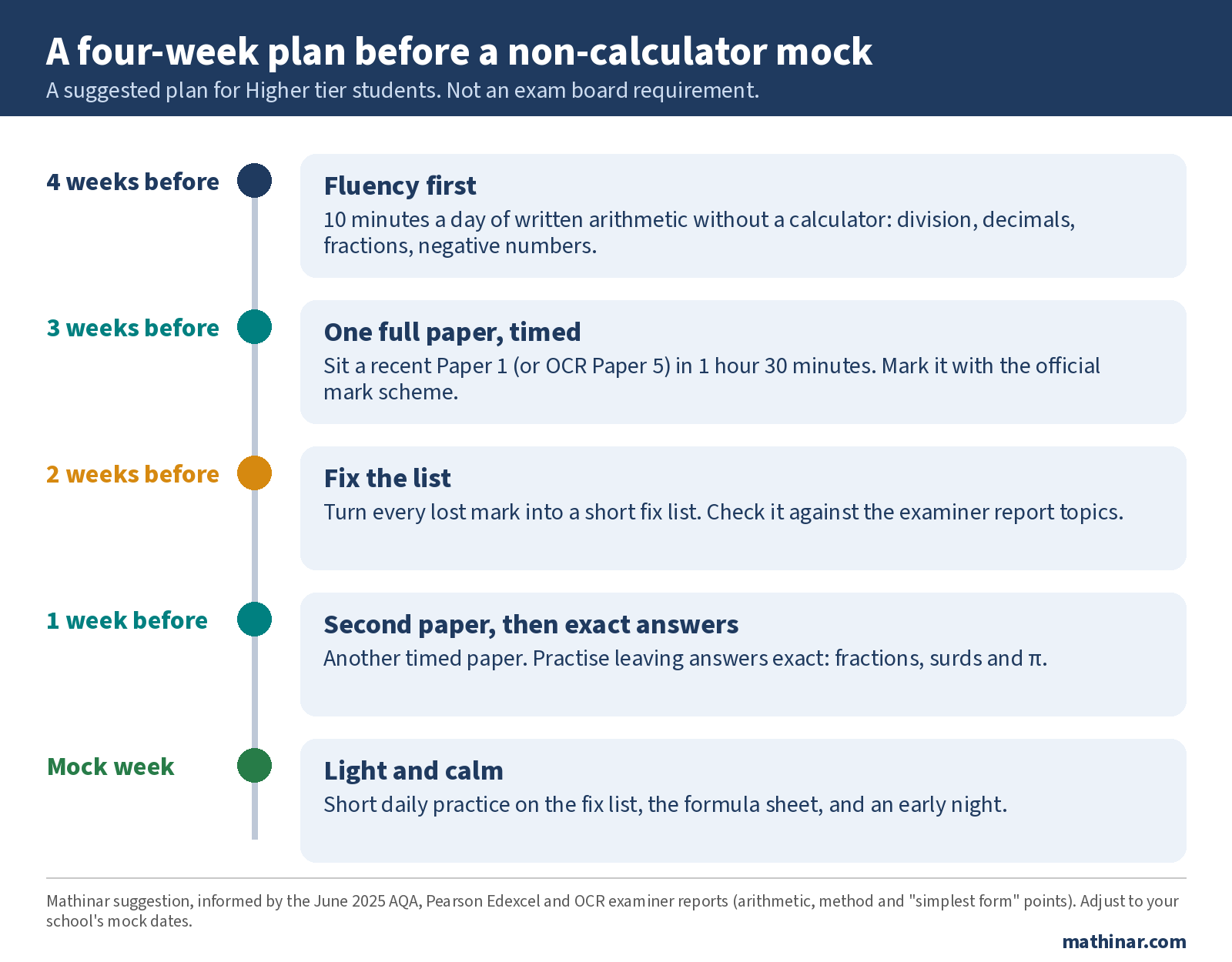
- Four weeks before: fluency first. Spend about 10 minutes a day on written arithmetic without a calculator: division, decimals, fractions and negative numbers. These are the areas all three reports flagged.
- Three weeks before: one full paper, timed. Sit a recent non-calculator paper in 1 hour 30 minutes, then mark it with the official mark scheme. The mark scheme shows where method marks are given.
- Two weeks before: fix the list. Turn every lost mark into one line on a fix list, such as "adding fractions with different denominators" or "algebraic proof with consecutive even numbers". Practise those, not the topics that are already secure.
- One week before: a second paper, then exact answers. Sit another timed paper. Practise leaving answers as fractions, surds and multiples of π, and re-read the last line of each question.
- Mock week: light and calm. Short daily practice on the fix list, a look at the formula sheet, and enough sleep.
Where to find non-calculator papers
The most recent public Higher non-calculator papers are from June 2025:
- AQA: June 2025 Paper 1H question paper, mark scheme and examiner report. Older Paper 1 papers are on our AQA GCSE Maths past papers page.
- Pearson Edexcel: June 2025 Paper 1H question paper, mark scheme and examiner report. Older Paper 1 papers are on our Edexcel GCSE Maths past papers page.
- OCR: June 2025 Paper 5 question paper, mark scheme and examiners' report. Earlier papers are on the OCR J560 assessment page.
If your child's school uses recent past papers for mocks, a paper done at home could spoil a mock, so it is worth checking with their maths teacher first.
Tips for parents
You don't need to be good at maths to help with the non-calculator paper:
- Ask to see the working, not just the answer. If the working is hard to follow, an examiner will find it hard too.
- Encourage a quick estimate. The Pearson report advises students to "check that answers are sensible". A rough estimate before or after a calculation catches many slips.
- Treat a weak mock score as information. The paper-by-paper detail matters more than one number. Was it arithmetic, a topic gap, or running out of time?
- Keep it regular and short. Ten minutes of arithmetic most days is easier to sustain than a long weekend session.
How Mathinar can help
Mathinar runs small online GCSE Maths group classes for students in Year 10 and Year 11, focused on the Higher tier. I teach every class myself. I have taught maths for more than 20 years and I am a GCSE examiner. Each week includes a 60-minute live teaching lesson and a 30-minute homework class. Groups have a maximum of ten students, and the cost is £97 a month. Lessons include a mix of core and stretch questions, and students can answer privately in the chat.
If you'd like to see whether the classes suit your child, you can try a group lesson free or read more about GCSE Maths at Mathinar. No grade can be guaranteed, but a clear plan and regular practice can help students show what they know.
Frequently asked questions
Is Paper 1 always the non-calculator paper?
For AQA and Pearson Edexcel, yes: Paper 1 is non-calculator at both tiers. For OCR, no. The non-calculator papers are Paper 2 (Foundation) and Paper 5 (Higher), which is the second of the three exams.
When is the GCSE Maths non-calculator paper in 2027?
AQA and Edexcel Paper 1 is on Friday 14 May 2027 (morning). OCR Paper 5 (Higher) and Paper 2 (Foundation) are on Thursday 27 May 2027 (morning). Always check your school's timetable.
Which topics only come up on the non-calculator paper?
None officially. AQA, Pearson and OCR all say that any content can be assessed on any paper. Some topics are more natural without a calculator, such as surds, exact trig values and recurring decimals, but they can appear on calculator papers too.
Do you get a formula sheet on the non-calculator paper?
Yes. For exams in 2027, students get the formula sheet on all three papers. Our formula sheet 2027 guide lists what it contains.
How many marks is the non-calculator paper worth?
It is one third of the GCSE for every board. AQA and Edexcel papers are out of 80. OCR papers are out of 100.
Is the non-calculator paper harder?
Not officially. Grade boundaries are set on the total across all three papers. In June 2026, the notional grade 7 mark on the non-calculator paper was 56 out of 80 for AQA, 49 out of 80 for Edexcel and 51 out of 100 for OCR. It can feel harder because slips are easier to make without a calculator, which is why regular arithmetic practice helps.
What is the most common way to lose marks?
The June 2025 reports from all three boards highlight arithmetic with fractions, decimals and division, and incomplete proofs. Pearson also points to not following "show all your working" and "simplest form".
How should my child use past papers?
Sit at least one full paper timed, in 1 hour 30 minutes, then mark it with the official mark scheme and make a short fix list from the lost marks. Check with school first so that a planned mock paper isn't used at home.
