
Easter is one of the most important turning points in your GCSE Maths revision.
Used properly, it can take you from a Grade 6 to a Grade 7… or from a 7 to an 8 or 9.
Used poorly, it becomes two weeks of “light revision” that doesn’t really move your grade.
And this is where most students go wrong.
The Reality Most Students Don’t Realise
Most Year 11 students aim for around 2–3 hours of revision per day during the holidays.
It sounds reasonable.
But think about a normal school day:
- 5 hours in lessons
- 2–3 hours of homework or revision
That’s already 7–8 hours of focused work per day.
So why does that suddenly drop during the most important revision period of the year?
Students who outperform their predicted grades usually don’t do anything unusual.
They simply increase the volume of focused revision during Easter.
A realistic target is:
- 6–8 hours per day (across all subjects)
- With 3–4 rest days across the two weeks
You don’t have to hit 8 hours every day.
But if you aim higher, you’ll almost always do more than you would have otherwise.

The Biggest Mistakes Students Make Over Easter
From my experience working with students — and marking exam papers — these are the patterns I see every year.
I’ve marked over 250,000 GCSE exam questions over the last 21 years, and the same issues come up again and again.
1. No clear plan
Waking up and deciding what to do on the day wastes your best thinking time.
2. Not reviewing mistakes
Students complete work but don’t fix the gaps.
This is one of the biggest reasons grades don’t improve.
3. Not doing enough exam questions
GCSE Maths is heavily based on familiar question types.
If you haven’t seen them before, they feel difficult.
If you have, they become predictable.
4. Starting too late
Waiting until May to begin proper exam practice is a huge disadvantage.
What a High-Impact Revision Day Looks Like
You don’t need to guess what to do each day.
A strong revision day is structured and repeatable.
You can organise your day in one of two ways:
- 8 × 60-minute sessions
- 5 × 90-minute sessions (recommended)
With breaks in between.
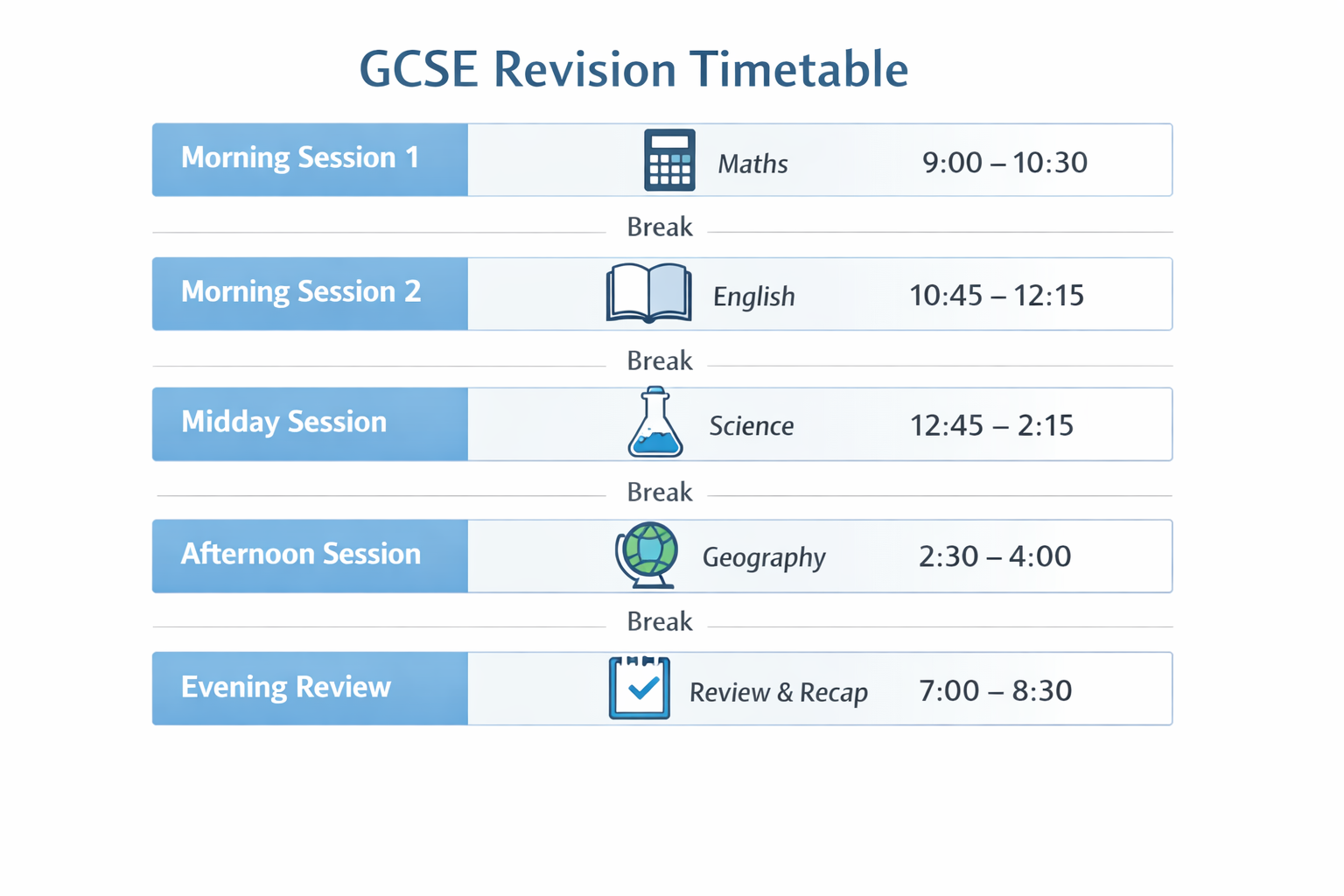
How to Structure Your Day
- Morning (best focus): Maths and hardest subjects
- Midday: Mixed subjects
- Afternoon: Exam practice
- Evening: Lighter work or review
Put Maths early in the day when your brain is at its best.
Take longer breaks later in the day as your energy drops.
At least 1 hour of maths per day during Easter is a good starting point.
One simple way to do this is by completing a short exam paper each day — something you can finish, mark, and learn from in under 30 minutes.

The GCSE Maths Strategy That Actually Works
The goal is not just to revise maths.
It’s to become familiar with exam questions.
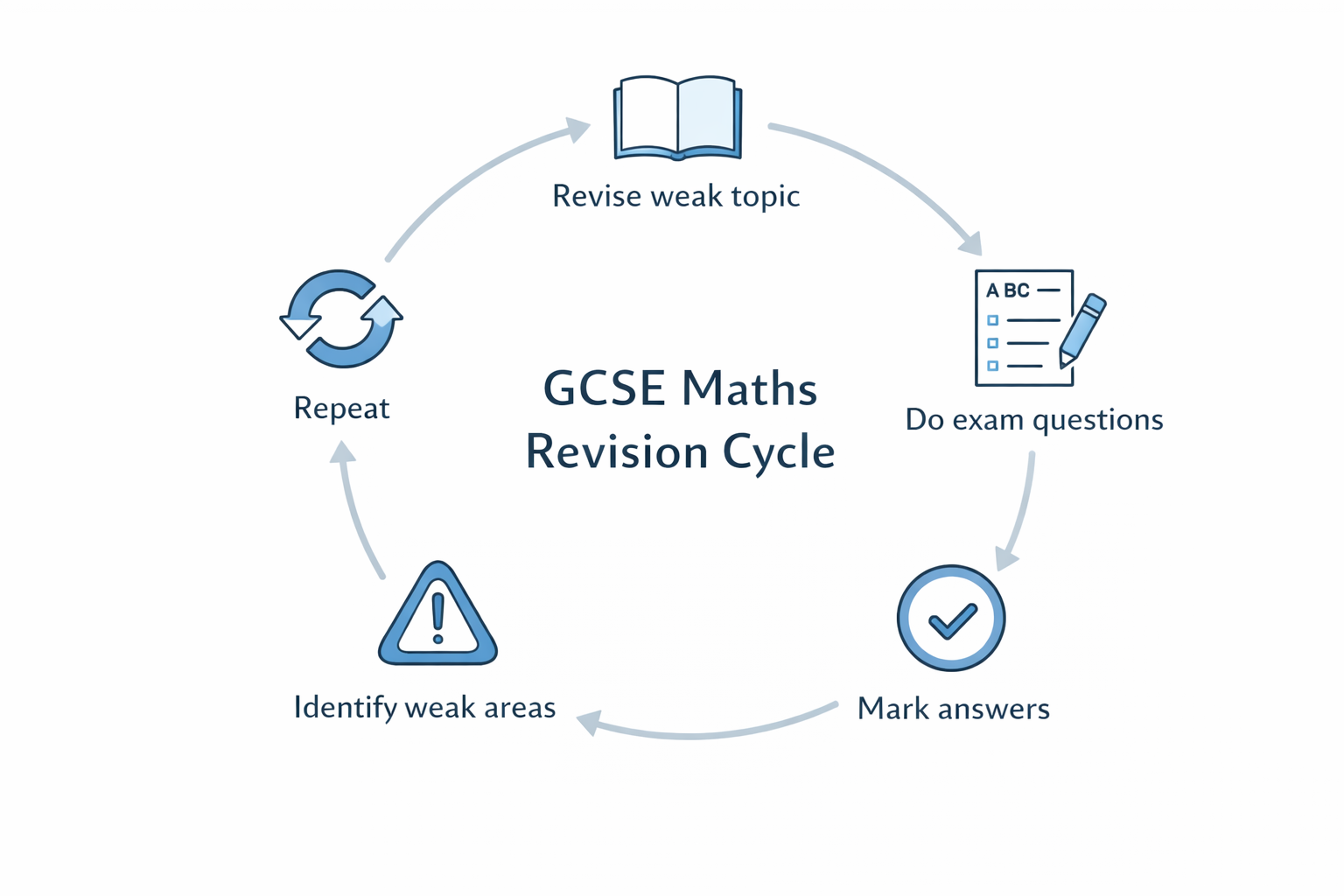
Step 1: Start with weak topics
Identify the topics you struggle with and focus on those first.
Step 2: Do exam questions immediately
Don’t wait until you feel ready. Start straight away.
Step 3: Mark your work straight away
Immediate feedback is where the learning happens.
Step 4: Build a weak topics list
After marking:
- Identify where you lost marks
- Write those topics down
This becomes your personal revision plan.
Step 5: Repeat the cycle
Revise weak topic → do questions → mark → update list
If you do this properly:
- Your list of weaknesses gets smaller
- The exam papers start to feel easier
Why Exam Practice Is So Important
GCSE Maths questions follow patterns.
There are only so many ways exam boards like AQA, Edexcel and OCR can ask a topic.
Once you’ve seen enough of them, you stop feeling stuck.
Students who do more exam practice:
- Work faster
- Make fewer mistakes
- Feel more confident

What NOT To Do Over Easter
If you avoid these, you’ll already be ahead of most students:
- Revising without a plan
- Re-reading notes instead of doing questions
- Leaving exam papers until the last minute
- Ignoring mistakes after marking
- Doing too little and thinking it’s enough
A Simple Habit That Makes a Huge Difference
At the end of each day, plan the next day in detail.
Decide:
- What subjects you’ll study
- When you’ll study them
- Exactly what you’ll do
This means the next morning:
- You start immediately
- You don’t waste mental energy
- You stay consistent
The Final 4 Weeks Before Your Exam
Easter isn’t the end — it’s the launchpad.
After Easter, your focus should shift to:
- Regular past papers
- Refining weak topics
- Improving exam technique
If you’ve used Easter properly:
- You won’t be catching up
- You’ll be improving
GCSE Maths Easter Exam Papers (Start Today)
If you want something simple to follow over Easter, this is exactly what I’d recommend.
I’ve put together a series of GCSE Maths Easter exam papers designed to help you build confidence quickly.

How it works
- One 20-minute exam paper each day
- Each paper focuses on a different GCSE Maths topic
- 30 papers in total
Each paper includes:
- Question paper
- Mark scheme
- Examiner’s report
Why this works
You don’t need to decide what to revise each day.
It removes:
- Wasted time
- Uncertainty
- Inconsistent revision
Because they’re only 20 minutes long, you can:
- Do one per day
- Or complete several in one session
Try it for free
You can get started with the first 7 days completely free.
Once you sign up:
- You’ll receive Day 1 immediately
- Then one new paper each day for the next 6 days
After that, you can continue with the full 30-day series.
Enter your email below to receive your first paper and get started today.
Final Thought
Most students don’t fall short because they aren’t capable.
They fall short because:
- They underestimate how much work is needed
- Or they don’t use their time effectively
If you:
- Plan properly
- Focus on exam questions
- And review your mistakes
You give yourself a real chance to outperform your predicted grade.
